Separate disclosure from proof
A Negotiated Contract Is Not the Court’s Account of It
A signed agreement records the parties' architecture, version and execution choices; a court decision records a disposition and reasons after a procedural contest. The opinion may quote the contract without becoming a clean substitute for it.
Records covered
Contract drafting and court decisions touch when an executed instrument becomes an exhibit or interpretive object in a judgment with a contested procedural history.
Establishes / only indicates
The instrument-and-opinion pair establishes the clause text beside the proposition actually decided in litigation; it only indicates how the dispute transformed the parties' original language.
Declines to state
It declines to generalize the judgment beyond its procedural posture or to supply the parties' omitted negotiating history.
The modern quotation hunt comes with a full entourage.
Search every reported use of your clause. Ask a legal-research system for its leading treatment.
Feed the agreement and the entire docket into a language model, with the calm glassy confidence of somebody ordering a custom kitchen on a tablet.
It’ll return a paragraph announcing that Clause 14.2 has been “judicially clarified.”
A phrase that has ruined more afternoons than it has improved.
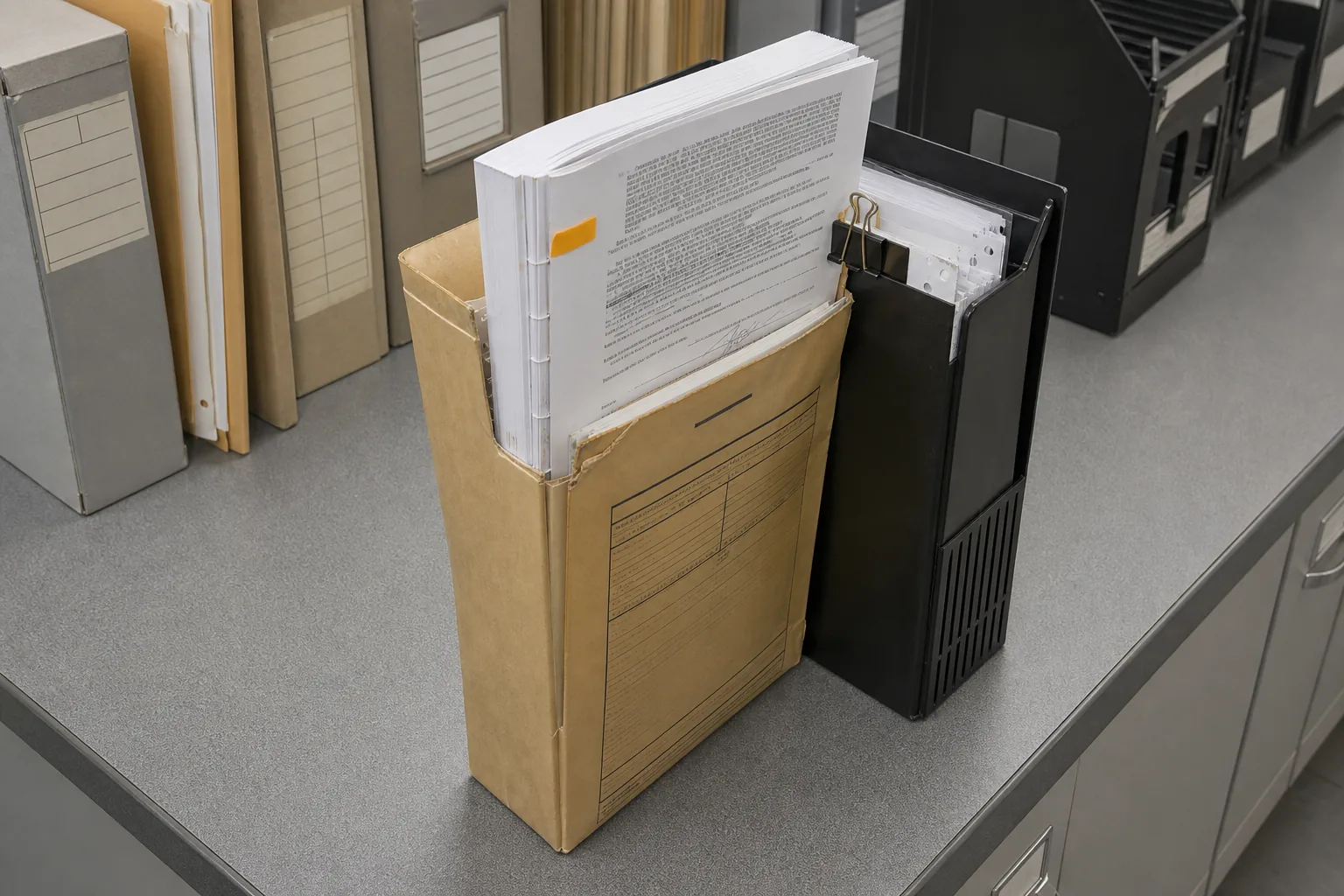
Across the table sits the signed package.
From a distance it looks plain.
Final text, schedules, signature blocks, the version that survived the redline, and an attachment called Schedule 4 - Final FINAL (2).pdf, because civilisation is a collaborative project.
It offers you no litigation narrative.
The opinion supplies that.
Along with a court, a date, a procedural posture, an operative result, reasons, and possibly a dissent that has packed its emotional belongings into an appendix.
Quoting the useful bit does not turn the opinion into a clean contract copy.
The pair isn’t a complete biography of the deal.
It’s enough to inspect the passage from an executed instrument to a litigated proposition.
Different jobs.
A designed object, not a quotation mine
Before drafting starts, the procedure uses two ledgers.
Your commercial ledger tracks parties, object, price or value logic, term, deliverables, decision dates, dependencies, operating people.
Your control ledger tracks governing-law assumptions, approval gates, signing authority, required formality, source documents, unresolved points.
Each entry gets one of four statuses.
Agreed.
Proposed.
Unknown.
Outside scope.
A judgment does not normally reproduce either ledger.
It meets your agreement after the meeting has become evidence.
The agreement then picks one of three shapes.
One self-contained agreement.
A master agreement plus orders.
A framework with statements of work.
That choice determines where your clause lives.
A price rule could sit in the main agreement, a rate card, an order form, a statement of work, or a document incorporated only for information.
A case quotation that says “the Agreement” has the leisurely confidence of a detective who hasn’t yet opened the schedule register.
Drafting runs in four passes.
Transaction spine.
Operational processes.
Definitions, schedules and cross-references.
Relationship controls.
That order matters here, because a defined term can point to a schedule and a schedule can point to an external policy.
Your contract is therefore not merely its best sentence.
It’s an architecture with plumbing.
A court may interpret the pipe that burst. The executed package tells you whether it was attached to the kitchen at all.
Negotiation keeps one controlled comparison copy and one issue log as its decision record.
A material change can concern a cap, a service metric, a termination trigger, a schedule priority, a signatory requirement.
The record separates a wording edit from the choice it implements.
By the time the opinion begins “the parties disputed,” your issue log may be unavailable, privileged, or simply lost in the professional fog bank known as email.
That absence is not filled by an elegant paragraph about contractual purpose.
Signature is an event with evidence
The closing workflow runs three checks.
It confirms your final PDF or locked native file contains every intended schedule, with no tracked changes and no unresolved brackets.
It confirms identity, entity name, signing capacity and formalities.
It confirms signing method, recipient sequence, and retention location.
A scanned signature page attached to an almost-right draft is an object with ambitions.
It is not automatically the authoritative executed package.
Counterparts exist for a practical fact. Parties may sign identical copies in different places, and those signed copies together constitute the instrument.
The operative adjective is identical.
A counterpart is not a spare copy carrying its own surprise rate card. Like a parakeet with a power of attorney.
Your contract record has to identify the version, and the schedules each signature attaches to.
Electronic execution makes the same point less theatrically.
For covered US interstate or foreign-commerce transactions, E-SIGN makes electronic form alone insufficient to defeat validity, while preserving other applicable requirements.
So your check has two parts.
Electronic method, and remaining formality.
The execution-assurance model then has three levels.
Identity, entity, title, date and immutable file identifier.
Then approval and audit trail.
Then jurisdiction-specific authority, witnessing, notarisation, legal opinion, or delivery mechanics.
Your platform receipt is evidence of a method.
It is not a universal pardon for every other requirement.
Closing produces four handover items.
The authoritative executed package.
An obligations extraction.
A calendar of time-based duties.
A change-control location.
For amendments, the workflow identifies the base instrument, maps affected schedules, obtains approval, attaches the final amendment, and updates the authoritative record.
It doesn’t silently merge amendments into a polished restated copy. Not unless the parties execute the restatement.
Your clean copy can be useful.
It isn’t necessarily the instrument.
The opinion has its own weather
The court record begins somewhere else entirely.
A litigation card uses six fields.
Court and date.
Procedural posture.
Judgment.
Issue resolved.
Holding or reason.
Publication or citation status.
Plus pinpoint pages and a source URL.
Already enough to make your quotation search look underdressed.
The judgment supplies what happened to the parties.
The opinion supplies the reasoning.
Not interchangeable.
And the decision carries at least four levels of commitment.
The judgment.
The holding.
Reasoning that supports without being indispensable.
Dicta.
A sentence starting “we conclude” is not issued a small badge reading HOLDING.
Its job depends on what had to be decided to produce the disposition.
For reporting, court material works in three layers.
What happened to the parties.
What controlling or joined reasoning says. What remains disputed, unaddressed, remanded, or assigned to separate opinions.
A concurrence can agree with the result and give a different route. A dissent can explain the losing position.
So your record of agreement has three parts.
What the court did.
What reasoning drew enough agreement.
What alternative reasoning individual judges supplied.
A memorable dissent doesn’t become the court’s account by winning the quotation contest.
Your verification pass has eight questions.
Issuing court.
Date and case identifier.
Opinion, order or judgment.
Operative action.
Issue producing the proposition.
Who joined.
Necessity to the result.
And whether the cited source shows the text rather than a summary.
That’s where your contract clause meets a court’s actual work.
If an opinion quotes the clause while dismissing for a threshold defect, the quotation and the disposition need not establish the same thing.
The court may have admired the furniture without buying the house.
Compare records, not atmospheres
The useful method retrieves the executed agreement and the decision interpreting it.
It doesn’t start with a quote, a headnote, or a vendor’s cheerful “case treatment” panel.
It starts by putting two bounded records beside each other.
EXECUTED INSTRUMENT                     COURT DOCUMENT
version / source file                   court / case name / date
included schedules                      docket or citation / source version
execution method and evidence           procedural posture / document type
clause and defined terms                disposition / issue / vote line
amendment and counterpart status        pinpoint / holding or other reasoning

COMPARISON
contract language | judicial proposition | level of commitment | limitation
The contract side records its two-to-four-level precedence ladder, where documents genuinely conflict. Plus the three roles for external material.
Incorporated and binding.
Referenced for information.
Excluded.
The decision side keeps five minimum identifiers.
Court.
Case name.
Date.
Docket or citation.
Version or source URL.
The two records are allowed to retain different facts.
That’s the point.
Trying to make them match completely is how a clause becomes a fable.
Then run three passes.
The instrument pass identifies your exact clause, defined terms, version, schedules, counterpart status and execution evidence.
The decision pass identifies posture, disposition, issue, joined reasoning, and the pinpoint in the source version you actually consulted.
The comparison pass says only what the two demonstrate together.
The instrument contains this language.
The decision took this procedural action. This proposition did, or did not, do necessary work in that action.
Headnotes and syllabi can help you locate the trouble.
They don’t get to solve it.
The verification sequence has three steps. Use the summary to find the issue.
Read the cited opinion passage.
Compare it against the judgment and the vote line.
Court versions deserve the same mild suspicion.
A slip opinion can later appear edited into United States Reports style, so an early PDF page number may not survive the trip.
A pinpoint without its consulted source version is a treasure map to a shopping centre that has been redeveloped.
Publication status belongs on the card too.
Rule 32.1 permits citation of specified US federal judicial dispositions issued on or after 1 January 2007.
The relevant court and local rules determine other treatment.
An unpublished label changes your retrieval and citation work.
It doesn’t make the text vanish, and it isn’t an excuse to cite a database summary instead of the document.
What the pair shows
Call it the instrument-and-opinion pair.
It is not a reconstruction of the negotiation.
It doesn’t decide what an omitted email would have shown, what every clause means outside the litigation, or what another court will do.
It places the executed architecture beside the disposition and the proposition actually decided. With versions, evidence and limits still attached.
For a pair of records, that’s plenty of work.
The procedure
- A controlled contract record keeps version control and the execution method beside the authoritative executed package.
- Counterparts are identical signed copies that together constitute one instrument, not spare copies with independent text.
- A decision record separates the disposition, holding, supporting reasoning, and dicta.
- A headnote or syllabus locates an issue but requires verification against the opinion, judgment, and vote line.
- A usable decision record preserves court, case name, date, docket or citation, and source version or URL.
- A pinpoint is recorded in the consulted source version because page references can change between a slip opinion and later report.
Questions
- What does an executed contract prove that a court opinion does not?
- An authoritative executed package records the agreement text, the included schedules, the parties, the execution method, and the evidence assembled at closing. It can also preserve approval and platform-audit evidence where that forms part of the closing record. A court opinion records a later disposition and reasons in a procedural contest. It may quote a clause without preserving every version, schedule, signature fact, or commercial decision that produced it.
- Are counterparts just extra copies of the same agreement?
- No. Counterparts solve a distribution problem: parties may sign identical copies in different places, and the signed copies together constitute one instrument. The identity of the circulated copies therefore matters. A counterpart is not a license for different schedules, unresolved brackets, or changed wording to travel under the same title. The authoritative record preserves the final package that shows which identical texts became the executed instrument.
- What needs to be checked before a contract is signed?
- The closing workflow uses three checks. It confirms that the final PDF or locked native file contains every intended schedule and no tracked changes or unresolved brackets. It then confirms identity, entity name, signing capacity, and any required formality. It finally confirms that the signing method, recipient sequence, and retention location match the closing plan. These checks distinguish a final instrument from an advanced draft wearing a signature block.
- Does an electronic signature settle every execution question?
- No. For covered U.S. interstate or foreign-commerce transactions, electronic form alone does not defeat validity under E-SIGN, while other applicable legal requirements remain. Execution analysis therefore has two parts: the electronic method and the remaining formality. Corporate authority, deed execution, consumer notice, local registration, witnessing, or notarisation can remain separate questions. The retained electronic record also needs to reflect the information accurately and remain accessible for the required period.
- What is the difference between a court's disposition and its holding?
- A disposition is the court's operative action, such as affirming, reversing, vacating, or remanding. A holding is the legal resolution necessary to reach that action on the material issue. The opinion can also contain supporting reasoning and dicta, which are observations or hypothetical applications not needed for the outcome. One case outcome therefore does not automatically establish one broad legal rule.
- Can a quote from a court opinion be treated as the rule of the case?
- No. A quotation can be a holding, supporting reasoning, dicta, a concurrence, or a dissent. Its grammar does not settle its status. The proposition is tested against the issue, procedural posture, judgment, vote line, and necessity to the result. If necessity is unclear, the accurate description is that the opinion said or reasoned something, rather than that the court held it.
- What information belongs in a record for a court decision?
- A basic decision record preserves five minimum identifiers: court, case name, date, docket or citation, and version or source URL. A litigation case card also records procedural posture, judgment, issue resolved, holding or reason, and publication or citation status. Separate opinions add author and opinion type. These fields identify the document read and limit a later description to the source and procedural stage it actually records.
- Can a headnote be cited as if the court wrote it?
- No. A conventional headnote is generally a publisher's summary and is not part of the judgment. It can locate an issue efficiently, but the verification sequence has three steps: use the headnote to find the topic, read the cited part of the opinion, and compare it with the judgment and vote line. A proposition that survives only in the headnote remains an editorial characterisation rather than the court's stated reasoning.
- Why does the version of a court opinion matter for a pinpoint?
- Court materials can change form after release. The Supreme Court begins with a slip opinion and later provides versions edited into United States Reports style. A page number copied from an early PDF can therefore differ from a later report. A case record keeps the consulted source version or stable URL with the pinpoint, so the quoted passage can be found in the document that actually supplied it.
- Does an unpublished decision disappear from research?
- No. A publication label changes research handling, citation treatment, and sometimes the weight a court assigns; it does not erase the decision. In U.S. federal appellate litigation, Rule 32.1 permits citation of specified unpublished or non-precedential dispositions issued on or after January 1, 2007, while local rules and the relevant court determine other treatment. The record retains the court's own label and source.
- What is the smallest reproducible way to compare a contract and a decision about it?
- The comparison retains the authoritative executed package and the consulted court document. It records the contract version, included schedules, execution evidence, clause text, and defined terms beside the court, date, case identifier, procedural posture, disposition, pinpointed reasoning, and source version. It then labels whether the quoted proposition is a holding, supporting reasoning, dicta, concurrence, or dissent. The comparison establishes the relationship between two records, not the missing negotiation history.
- Why is a clean restated copy not always the executed agreement?
- An amendment workflow identifies the base instrument, maps affected schedules, obtains the required approval, attaches the final amendment, and updates the authoritative record. It does not merge executed amendments into a silent restated clean copy unless the parties execute that restatement. A convenient consolidation can aid reading, but the source documents remain the records that establish how and when the text changed.