Test a compliance claim
A Regulatory Filing Is Not an Official Notice: One Reports an Operation and the Other Changes Its Public Legal Setting
A sector filing can report a measured condition; an official notice can announce an action, deadline, or operative text. They meet at the regulated event, not at a shared claim to authority.
Records covered
A government-notice system publishes an official action and a sector filing reports an operator’s specified condition; they meet when the action supplies the legal setting for the later report.
Establishes / only indicates
The comparison establishes the separate authority, date, and object of the notice and the filing; it only indicates how a published action may frame a reporting duty.
Declines to state
It declines to infer compliance or non-compliance from the existence of either document.
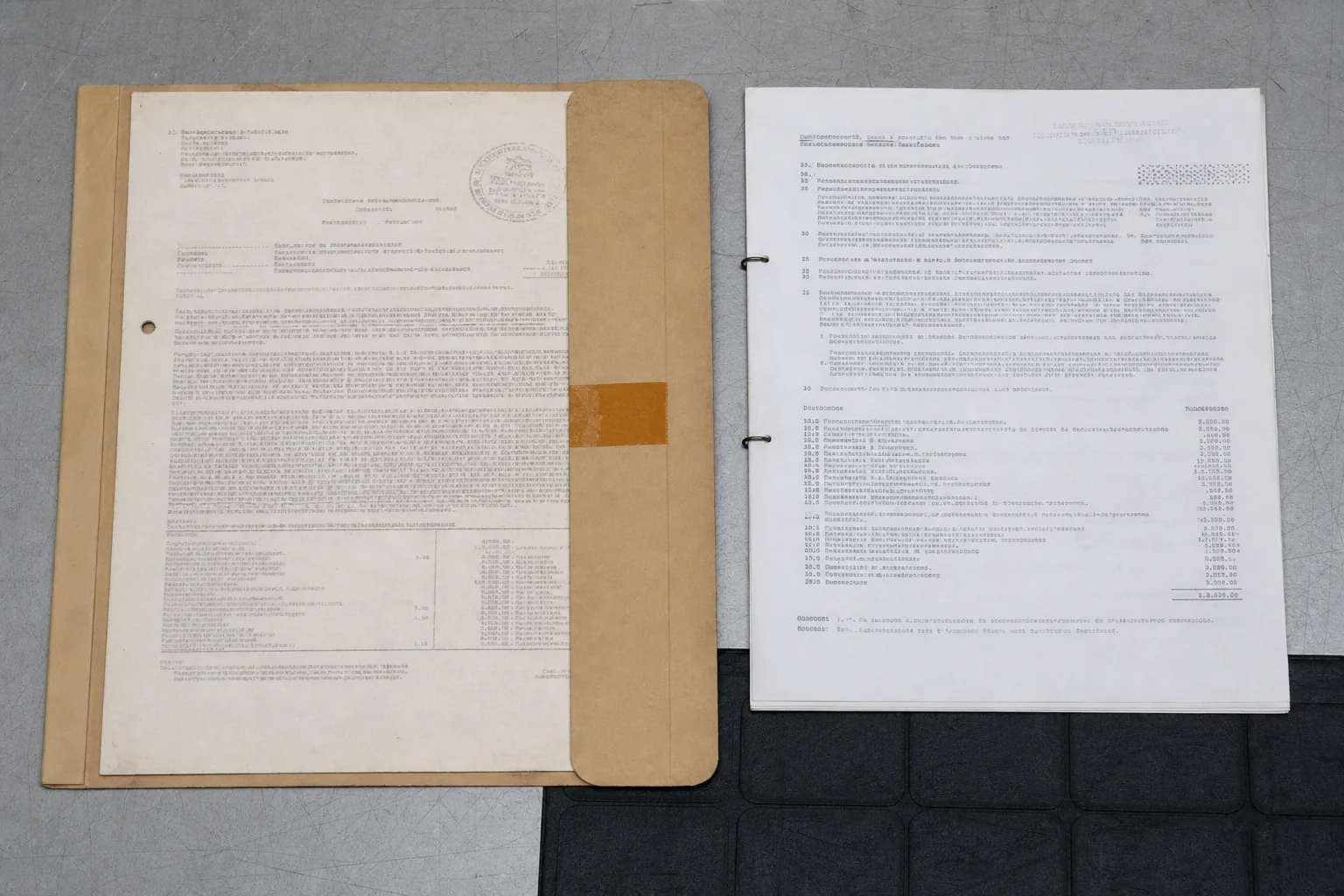
Compliance platforms.
Obligation engines.
A dashboard with a miniature radar sweeping across every facility in North America, pausing briefly over a warehouse in the manner of a police procedural that has mistaken a spreadsheet for a suspect.
The dashboard receives an official-looking PDF and a filing-shaped CSV. It gives both a blue checkmark.
It has completed its thought.
Then the documents arrive.
One is a notice.
One is a filing.
They both look official because governments have discovered serif fonts.
That is not a shared claim to authority.
A notice can announce, set, designate, suspend, grant, require, or record.
A sector filing can report a value or a narrative, for a reporting unit, a period, a form, and a schedule coordinate.
They touch at the regulated event. A published action may establish the legal setting in which you later report.
The notice doesn’t become a measurement because it mentions a facility.
The filing doesn’t become an official act because it has a reference number and a cover sheet brave enough to say “submitted.”
One glow, several jobs
Your filing family offers four cadence modes.
Annual completed-period.
Quarterly completed-period.
Event driven.
Biannual snapshot.
A 10-K is annual.
A 10-Q is quarterly.
An 8-K is a current report for material information before the next scheduled report.
FCC Broadband Data Collection filings go in twice a year.
None of those is an announcement clock.
Each one tells you when a particular kind of reported record can exist. With a particular lag, and a particular scope.
Your notice has a separate administrative life.
Its legal-operation field gives you four values.
Binding norm.
Legally required publication step.
Procedural communication.
Official information.
A Federal Register Notice can contain an administrative order. A Rules and Regulations item can be an interpretive rule or a policy statement.
The label on the folder is useful. It doesn’t get to be the legal consequence, however much it has dressed for the occasion.
Your objects diverge too.
A TRI entry can be one facility-and-chemical record. A Call Report is bank-specific. A hospital cost report is provider-specific. A broadband record can be location-specific.
The notice may concern a regulated class, a named addressee, or a public-interest audience.
Three audience fields.
And not one of them is a reporting-unit selector.
“The public” is a reach description. “A facility-and-chemical entry” is a measurement boundary.
Don’t introduce them at a dinner party as though they know each other.
Which is why your company total is usually sitting inside neither document.
To produce one from environmental filings, you have to decide which facilities, chemicals, source categories and reporting-year revisions enter the total.
That output is an analyst-derived total. Not a native facility value.
A sector filing gives you one operational view. A notice gives you a public legal setting.
The resemblance is paperwork, which is a notoriously weak form of kinship.
The notice owns several clocks
Your notice record carries six time fields, wherever the publication system supplies them.
Signature or decision date.
Filing date and hour.
Public-inspection availability.
Official publication date.
Effective or operative date.
Deadline or expiry.
A filing record adds its reporting period and its filing or acceptance date.
SEC search results expose a reporting date and a filing date separately.
Those two fields are not duplicate decor placed either side of a horizontal rule.
The familiar US rule makes your awkwardness productive.
The Administrative Procedure Act generally calls for at least 30 days between publication and effective date for substantive rules.
With exceptions for relieving rules, interpretive rules and policy statements, and good cause.
So a rule can be published before it operates.
A deadline in a notice can fall earlier or later than that operation date.
And a scheduled filing can cover a completed period that predates all of them.
The calendar icon has been relieved of duties it was never qualified to perform.
Your notice also needs a retrieval identity. Not just a handsome headline.
Its minimum key wants five fields from you.
Journal title.
Series or section.
Issue or publication date.
Document locator.
Issuing body.
Federal Register citations conventionally retain volume, page and date, and the system connects regulatory documents to CFR parts affected.
The European Union permits lookup by date, series, year and document number.
Your electronic record also needs the publisher’s persistent URL or document identifier.
A browser address can contain the emotional residue of a search session rather than the item.
Version is its own field on your card.
Your notice can be a legally authentic version, a publisher-designated official reproduction, or a convenient unofficial copy.
Three positions.
Not an attractive continuum from “PDF” to “more PDF.”
Since 1 July 2013, only the electronic Official Journal of the European Union is authentic and produces legal effects.
Its electronic signature is intended to protect authenticity, integrity and inalterability.
That’s a fact about that system. Not a decorative passport stamp for every agency webpage.
On 1 October 2023, the EU moved from issue-level collation to individual authentic PDFs.
The contrast is useful to you. Official publication can be a dated issue, or an item-level record.
The first gives you a bounded edition. The second gives you immediate linking and correction handling.
Neither tells you what a later operator measured.
It establishes only how the public action entered the journal’s world.
A filing number needs its address
Your filing needs seven identity fields before a number is allowed to leave the building.
Filing family.
Form variant.
Filer.
Reporting unit.
Reporting period.
Filing or acceptance date.
Amendment or status.
“2025 report” is not enough.
It might mean calendar-year activity reported later, a fiscal year ending in that year, a quarter, or availability at a filing snapshot.
Keep the report date beside the filing date. Even if your dashboard finds this unnecessarily sentimental.
Then comes your number’s actual address.
Its minimum measure coordinate has five parts.
Schedule or worksheet.
Line or field.
Column.
Reported unit.
Sign convention.
The label “deposits” can describe a balance, a flow, an average, a subtotal, or a value reported in thousands of dollars.
A physical quantity needs its real unit and its pathway from you.
Pounds or kilograms.
On-site release or off-site transfer. Treatment, recycling, or recovery for energy.
A Form R is one chemical report, from one facility, in one reporting year.
It is not an invitation to declare “the plant’s pollution” and leave early.
Your measure itself has six roles.
Stock.
Flow.
Capacity.
Activity.
Price or revenue.
Method.
Hospital cost-report material can include facility characteristics, utilization, costs and charges by cost centre, Medicare settlement, and financial-statement data.
A cost is not automatically a charge, a utilization count, an allocation, a reimbursement amount, or a facility characteristic.
For broadband, fixed availability and subscription are separate data types.
A location-availability file doesn’t supply you with a customer count because the map coloured in an appealing rectangle.
Every metric keeps four qualification fields of yours too.
Accounting or estimation basis.
Population scope.
Consolidation treatment.
Stated exclusions.
GHGRP source-category guidance specifies gases, calculation method, reporting information, and records to maintain.
A calculated annual quantity is not silently promoted into a direct continuous measurement.
A Fabric location ID belongs to a standardized list of locations where fixed broadband can or could be installed.
It is not automatically a postal address, a customer account, a building unit, or a census population.
Source state is not an accusation
Your notice preserves four authority fields.
Issuer.
Enabling source.
Action caption.
Operative clause.
It also preserves five evidence fields.
Source URL.
Publisher or repository.
Version status.
Authenticity status.
Access date.
Its relationship field lets you say corrects, supersedes, withdraws, implements, or related to.
Which means a correction doesn’t have to perform a small magic trick in which an old publication event never happened.
Your filing preserves six provenance fields.
Source URL.
Accession or download identifier.
Retrieval date.
Filing version.
Transformation made.
Evidence note.
The evidence note labels the value as original submitted, agency-extracted, analyst-derived, or crosswalked.
CMS’s hospital public-use file contains a subset of the variables available in HCRIS.
So the absence of a field from that extract is not evidence that the provider reported zero, or that the system never collected it.
It’s an absence from an extract.
Government datasets are quite capable of being incomplete without concealing a conspiracy in a dropdown menu.
Status needs the same restraint from you.
CMS uses five HCRIS status codes.
As submitted.
Settled without audit.
Settled with audit.
Reopened.
Amended.
A later file can supersede an earlier submission for the same period.
FCC says availability data are generally public, while subscription data and supporting data can receive confidential treatment.
Public, confidential, withheld and unavailable are four different access states.
So are blank, zero and not applicable.
Your blank does not need a motivational speech.
It needs a code.
Put the pair on one card
Pick one notice, and one filing it affects.
Don’t start with an entity graph, or a dashboard whose map is breathing.
Start with the official version, the filed image or agency extract, and the card below.
Your card doesn’t infer that the operator complied. It records what the notice says it does, and what the filing says it reports.
NOTICE
journal | series/section | publication date | locator | issuing body
issuer | enabling source | action caption | operative clause
decision date | filing time | inspection availability | effective date | deadline
affected class | response: action / channel / deadline
version status | authenticity status | source URL | access date

FILING
filing family | form variant | filer | reporting unit | reporting period
filing/acceptance date | amendment/status
schedule/worksheet | line/field | column | unit | sign convention
measure role | basis | scope | consolidation | exclusions
source state | download identifier | transformation | evidence note

LINK
published action | stated reporting connection | exact limitation
Run three passes.
Identity.
Does the journal locator identify the notice? Do form, filer, unit, period and status identify the filing?
Semantics.
Does the operative clause say what you’re attributing to the notice? Do the schedule coordinate, unit, basis and scope say what you’re attributing to the value?
Provenance.
Is the notice version properly labelled? Is the filing value filed, extracted, derived, or crosswalked?
That third pass is where a lot of polished certainty gets quietly sent home in a taxi.
What the card decides
Call it the legal-operation card.
It tells you a published action supplies a legal setting for a scheduled report.
It can tell you a public value is an agency extract rather than a filed value.
It can tell you a purported effective date is unstated, that a blank is confidential, or that a number’s unit is pounds rather than a percentage.
It cannot tell you, from the existence of these two documents, whether the operator complied.
That question has brought more paperwork.
The procedure
- Notice publication and legal effect are separate recorded facts.
- A notice can be identified by journal, series, publication date, locator, and issuing body.
- A filing value requires form, reporting period, schedule coordinate, unit, and status.
- Filed values, agency extracts, and analyst-derived values are distinct source states.
- A notice record preserves authority, operative clause, affected class, response, and version status.
- Blanks and status codes remain recorded conditions rather than convenient zeros or conclusions.
Questions
- Is a regulatory filing the same thing as an official notice?
- No. A sector regulatory filing reports information about a defined reporting unit, period, measure, and form. An official notice publishes an action, deadline, operative text, or other official communication within its notice system. They can concern the same regulated event, but the filing supports a claim about what the operator reported and the notice supports a claim about the published action and its stated legal setting.
- Which dates matter when a notice affects a reporting duty?
- A notice record keeps the signature or decision date, filing date and hour, public-inspection availability, official publication date, effective or operative date, and deadline or expiry where they exist. These dates serve different functions. Publication can precede legal effect, and a response deadline can differ from both. A filing record separately preserves its reporting period and filing or acceptance date.
- What makes an official notice easy to find again?
- A notice is retrieved with a five-part identity key: journal title, series or section, issue or publication date, document locator, and issuing body. An electronic-journal record also retains the publisher’s persistent URL or document identifier. A headline is display text rather than a reliable primary key because it can be amended, repeated, truncated, or translated without identifying the publication event.
- What has to stay attached to a number in a regulatory filing?
- A filing value remains reproducible only when the record keeps the filing family, form variant, filer, reporting unit, reporting period, filing or acceptance date, and amendment or status. The value also needs its schedule or worksheet, line or field, column, reported unit, and sign convention. A bare numeral can represent a balance, flow, average, subtotal, currency scale, physical quantity, or percentage basis.
- Does a notice’s publication date tell when it takes effect?
- No. Publication and legal operation are separate facts. For U.S. substantive rules, the Administrative Procedure Act generally provides at least 30 days between publication and effectiveness, subject to listed exceptions for relieving rules, interpretive rules and policy statements, and good cause. The record preserves the stated effective date and any stated exception rather than calculating a date from publication.
- What does a notice have to say before it can be treated as an official action?
- A notice record separates issuer, enabling source, action caption, and operative clause. The issuer identifies who placed or signed the item; the enabling source identifies the authority invoked; the caption labels the item; and the operative clause states what it says it does. The record then classifies the claimed legal operation as a binding norm, legally required publication step, procedural communication, or official information.
- Is an agency data extract the same as a value filed by the operator?
- No. Provenance distinguishes original submitted values, agency extracts, analyst-derived totals, and crosswalked records. An agency extract can be a useful public source without containing every field originally submitted. An analyst total can be reproducible when its included units, reporting-year revisions, transformations, and evidence note are recorded. The source state identifies what the value is, not whether it is correct or compliant.
- What does a blank field in a regulatory dataset mean?
- A blank field is a coded condition, not automatically zero. It can mean that a value is confidential, not publicly available, unavailable in a selected extract, not applicable, or otherwise not supplied by the display. Filing status also remains separate: CMS hospital cost reports use as-submitted, settled without audit, settled with audit, reopened, and amended statuses. The record preserves the displayed blank and status rather than supplying an interpretation.
- Can an official website page prove that a notice is legally authentic?
- Not by itself. A notice version can be legally authentic, a publisher-designated official reproduction, or a convenient unofficial copy. The governing system determines which status controls. Since 1 July 2013, the European Union treats only its electronic Official Journal as authentic and legally effective, with an electronic signature intended to protect authenticity, integrity, and inalterability. That jurisdiction-specific rule does not automatically apply elsewhere.
- Does public publication mean every affected person received individual notice?
- No. Notice systems use different reach mechanisms: universal publication, publication to a defined class, named-person service supplemented by publication, and internal governmental circulation. U.S. federal publication rules can provide legal notice to persons subject to or affected by a covered document, while other statutes and cases can require more. Public visibility does not establish that each person actually read the item or that individual service was unnecessary.
- What is the smallest check that links a notice to a later filing?
- The check records the notice’s journal locator, issuer, enabling source, action caption, operative clause, publication date, effective date, deadline, version status, and affected class. It then records the filing form, filer, reporting unit, reporting period, schedule coordinate, unit, source state, and status. The comparison states only the documented connection between the published action and the reporting field or duty.
- Do a notice and a filed report establish that the operator complied?
- No. A notice establishes what was published and, where stated, the action, date, deadline, or legal operation it announces. A filing establishes that a value or narrative was submitted, accepted, extracted, or derived under the recorded source state. Compliance requires a separate assessment of the applicable rule, the operator’s conduct, the complete record, and any governing process. Neither document alone decides it.