Investigate what is missing
Archival Survival Is Not a Retention Schedule
Documentary history shows what a form made recoverable, comparable or queryable after the fact; records retention governs the controlled path from active record to hold, destruction or archival transfer. Survival is evidence of a route, not proof of a policy.
Records covered
Documentary history reads the surviving form and custody of a series, while records retention controls its scheduled fate; they meet at the record of how that series was preserved or transferred.
Establishes / only indicates
The custody record establishes how a surviving series was transferred, described, or preserved; it only indicates, rather than proves, the authority that spared it.
Declines to state
It declines to treat an omission as proof of nonexistence or a surviving copy as proof that every comparable record was retained.
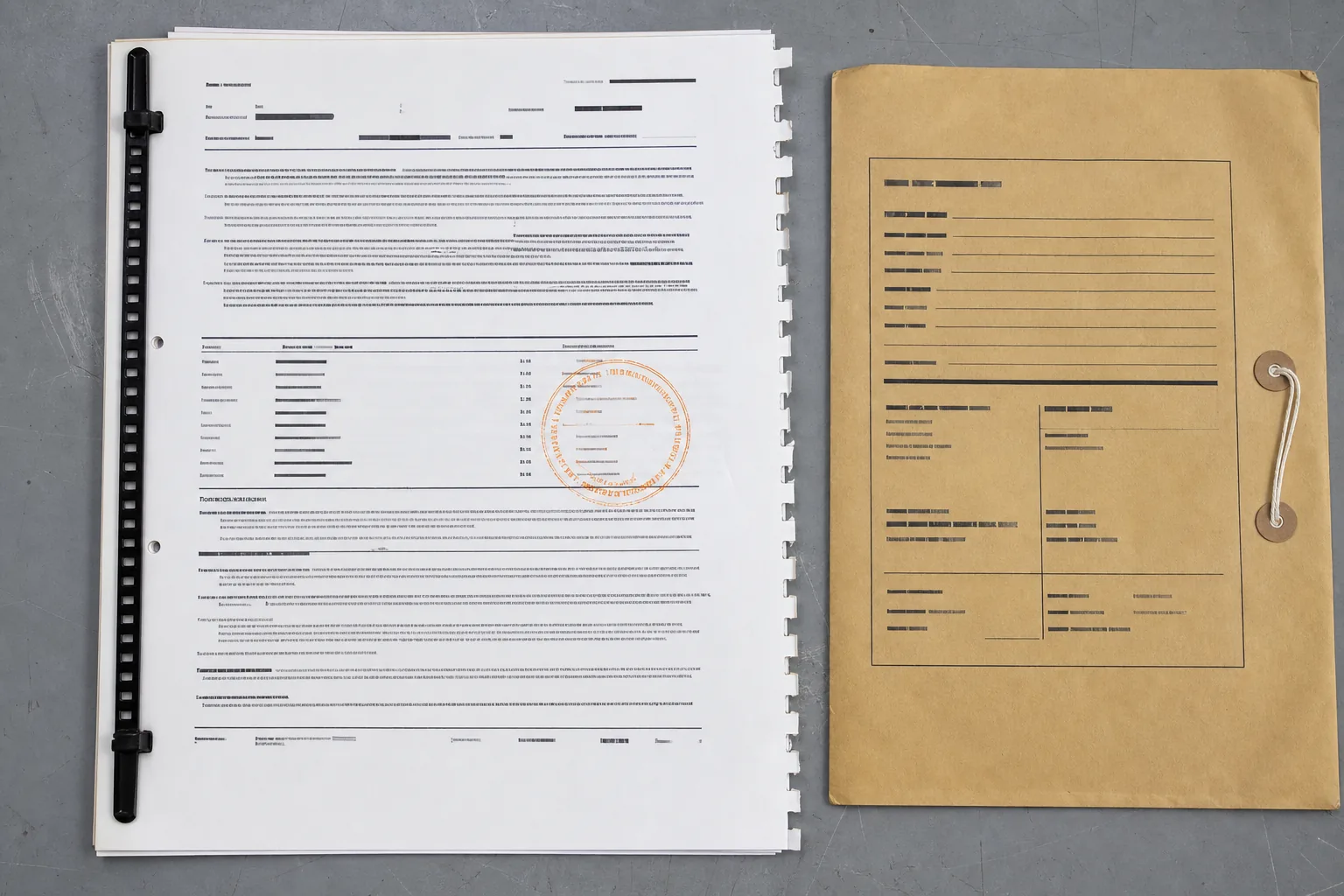
Storage analytics.
Digital-preservation maturity models.
A consultant with a canvas bag describing your records estate as a living ecosystem, while a dashboard assigns “resilience” to three boxes of procurement files and a spreadsheet called final_FINAL_v7.
Somewhere a software vendor is drawing a Sankey diagram from “data exhaust” to “institutional memory.”
The arrows are very calming.
Then there is the surviving thing.
It has an accession number, perhaps.
Or a box label, a catalogue description, a roll reference, a checksum, a storage location, an old seal hanging from a cord with the air of a retired admiral.
It may be one enrolled copy from 1199 in Chancery’s C 53 series.
It may be a Federal Register notice from the run that begins in 1936.
It may be a data export whose filename is not its RecordID.
A distinction NARA makes with some firmness, because computers can give one object several identities and then act surprised when everybody gets lost.
The survivor is useful.
It is not a retention schedule.
A record survives by a route
Documentary history asks you what a form made possible after the fact.
A charter made a claim portable.
An enrolment gave an office its own memory when the recipient-held original wandered away.
A register made entries comparable.
A serial publication made notice findable.
A database made changing states queryable.
That’s a history of documentary capacity.
It doesn’t tell you whether your current case file should be destroyed, held or transferred.
The two questions live next door.
They don’t share a toothbrush.
Take the royal grant.
The National Archives says an original charter will rarely stay in central custody, because it went to the recipient.
Chancery’s enrolled copies survive in C 53 from 1199.
The original rolls run to 1517, when charter enrolments stopped and later grants moved to Patent Rolls.
That sequence gives you an excellent route for your historical search. Recipient archive, then Crown series, then the relevant later series.
It doesn’t prove every grant in the same kingdom had the same surviving path.
And it doesn’t retroactively reveal a disposal authority written for a modern records centre.
Your office copy has an administrative personality.
It never promises to be the recipient’s original.
It promises you something more limited and more workable.
This office entered this text, in this series, in this order, and could later find its neighbours.
So a missing original may be a lost recipient-held object rather than a lost act.
But a missing enrolment isn’t automatically a lost act either.
Before you let absence wear a tiny detective hat, establish your relevant series, its rule of entry, its chronological span and its survival.
Registers make the temptation worse, because they look like populations.
Great Domesday has more than 800 pages, was copied principally by one scribe, and records holdings and values across much of England.
Its inquiry compares holdings at three dates.
Before the Conquest.
At William’s grant.
And in 1086.
It also doesn’t cover all territory.
The point isn’t that a register failed at census work.
The point is that its entry rule decides what you can compare.
Your convenient spreadsheet row is not the unit.
The record-making rule is the unit, and it’s considerably less willing to be interviewed.
The seal is not a brass witness
The same thing happens when an image of a seal turns up in your search result and starts radiating certainty.
The National Archives’ seal holdings span the 11th through 20th centuries.
Some images are online.
Others require in-person consultation.
Your image can omit edge damage, reverse impressions, attachment details, and the relation to other items in its file.
The seal wants credit for its channel of authentication.
It does not volunteer to prove the underlying transaction, the issuer’s power, or every condition attached to a sentence written beside it.
Read your seal with its placement, attachment method, legend, device, counterseal where present, text and custody.
A detached seal, a replacement cord, a later docket or an archival rearrangement changes your question.
That isn’t antiquarian fussing.
It’s source control for an object that has already had several careers.
The same restraint applies to a carbon notation or a distribution list.
The Library of Congress identifies carbon paper, typewriters, mimeographs and photocopiers as successive copying technologies.
Later copiers added collating and double-sided functions in the 1970s.
Electrophotography was invented in 1937.
A copy can show you distribution.
It cannot become the final version by appearing in four folders and looking busy.
Serial publication has its own clean boundary.
The Federal Register is published each federal working day, and includes regulations, proposed rules, notices, executive orders, proclamations and related presidential documents.
Its public run gives you a dated, citable announcement.
It establishes when and how notice became findable.
It doesn’t reconstruct the drafts, comments, routing slips or internal deliberation that came first.
Public history and working history are separate rooms.
The fact that both rooms have filing cabinets is not a merger agreement.
Retention starts earlier
Your retention schedule doesn’t begin with a beautiful box in an archive.
It begins with an inventory that makes your object governable.
Your basic inventory has four fields.
Business function.
Records created by that function.
System or physical location.
Accountable owner.
Add format, date span, annual growth, access restrictions, and an existing authority where you know it.
Then group your material into a series sharing the same disposition authority and date.
NARA requires separate records-centre transfers by series and cutoff date.
The series is your controlled aggregate.
The departmental shared drive is only where the aggregate has been hiding.
This is where survival and retention shake hands.
Briefly, and without becoming friends.
Your inventory can reveal a primary system record, an export, email attachments, paper originals, chat content, a data-warehouse extract.
Some are authoritative.
Some are controlled duplicates.
Some are transitory convenience copies.
That last category has produced considerable optimism immediately before somebody deletes the only usable export.
Classification comes before your disposal.
An unscheduled record doesn’t get an expiry date you improvised.
In the US federal model it’s treated as permanent until final disposition receives approval.
Every controlled series ends in one of two fates. Destruction on a schedule, or transfer to an archive.
That’s a scheduled outcome, assigned by approved authority after appraisal.
Not a feeling a system owner develops while paying for cloud storage.
Your clock has three common cutoff families.
Age-based.
Event-based.
Block-based.
“Destroy when 3 years old,” “destroy 7 years after case closure,” and “transfer 15 years after supersession” are not variants of one instruction.
They start from different events.
NARA’s example of transfer 15 years after cutoff in 5-year blocks is a federal example.
Not a universal archival horoscope.
The federal transfer range makes the point more sharply.
NARA describes 15 to 30 years after cutoff as the standard range for federal permanent records, and identifies 30 years old or older as the general transfer point.
Classified records ordinarily aren’t approved for transfer before 25 years.
Unclassified early transfer below 15 years, and late transfer over 30, need more information.
Those numbers describe one authority’s operating range.
They don’t turn a box surviving in a university basement into evidence that somebody correctly applied a 30-year rule.
A hold is an interruption
And your schedule still isn’t allowed to run unattended.
A hold has five scope dimensions.
Matter.
Custodians.
Repositories.
Time interval.
Subject or record type.
The working procedure has five actions.
Define scope.
Identify custodians and repositories.
Suspend deletion and disposal.
Send and track notices.
Monitor acknowledgement and collection.
A central register keeps the start date, the scope version, the affected series, the repositories, the owners, the exceptions and the release authority.
“Legal hold: yes” is not a model.
It’s a sticker.
Release isn’t an automatic purge with a better haircut either.
Written release removes your named interruption.
Then items beyond their regular date return to ordinary disposition review.
If three matters overlap the same mailbox, releasing one leaves the other two standing.
NARA’s frozen-records material describes one records-centre extension route of up to 1 year, alongside broader freezes.
A particular route.
Not a standard duration for every preservation matter with a memorable name.
Your permanent material takes a different exit.
Seven transfer checks.
Permanent designation.
Eligibility.
Holds and restrictions.
Inventory.
File and metadata validation.
Transfer request.
Receiving-archive acceptance.
The US electronic path starts you at permanent scheduling with no current business need. Then an ERA 2.0 request, archivist review, approval, transmission.
Its legal-transfer types include Annual FRC Move, Direct Offer and Pre-Accession.
A standard records-centre box is 1 cubic foot for transfer and billing.
All richer than “put it in storage.”
Which is why storage keeps trying to introduce itself as preservation, and keeps being politely asked for its authority.
The package itself carries four variables.
Authority.
Content inventory.
Technical representation.
Descriptive metadata.
Your structured data export can require its data dictionary, relational schema, code lists and query context.
Files alone don’t explain their relationships.
NARA requires documentation adequate to identify, service and interpret permanent electronic records.
Individual emails need not always be grouped into PST, though account-level aggregation can beat managing thousands of messages.
Your package has to preserve enough context to stop an archive becoming a climate-controlled pile of nouns.
The view is not the system
Database survival is especially good at impersonating certainty.
A dashboard total, a CSV and a printable certificate can show you related data without being the same record.
A database makes relationships and changing states queryable, through fields, identifiers, permissions, authority tables and software rules.
NARA’s permanent-record metadata guidance requires a unique RecordID, and permits terms to repeat where appropriate across 15 high-level metadata properties.
A filename is separate.
Which is deeply inconvenient to any investigator who has already named a download proof.csv.
Your small routine is to preserve the route beside the survivor.
For one series, record the documentary layer, the custody, the scope, the known omissions, the retention authority, the cutoff event, the transfer metadata, and your query or export date for any database view.
Then run the two passes the document demands of you.
First: what did this form make recoverable, comparable, or queryable?
Second: what authority, trigger, hold and transfer event governed the series?
The first establishes a documentary capability.
The second establishes a lifecycle control.
Neither should borrow the other’s trousers.
SURVIVING SERIES
documentary layer | series title | rule of entry | date span | custody
known omissions | source or system | identifiers | fields / filters | retrieved_at

LIFECYCLE ROUTE
business function | accountable owner | disposition authority | final fate
cutoff family | cutoff event | hold status | transfer or destruction event
inventory / accession reference | receiving custody | limitation
The chain you can show
Call it the survival record.
It doesn’t prove the forgotten file never existed.
It doesn’t prove every comparable record was retained.
It doesn’t convert an accession receipt into the original schedule. Or a schedule into proof that the system executed every instruction.
It records the chain you can actually show somebody.
Surviving form.
Bounded population.
Custody.
Authority where known.
And the dates and metadata that carried it across the threshold.
The procedure
- A documentary claim identifies whether it relies on an outward instrument, enrolled copy, register entry, later copy, catalogue description, or database output.
- Seal evidence is read with attachment, text, and custody rather than as a free-floating proof of the underlying transaction.
- An omission becomes usable negative evidence only after the series rule of entry, chronological span, and survival are established.
- An inventory maps business function, records created, location or system, and accountable owner into a retention series with an authority and disposition date.
- A retention rule records final fate, cutoff trigger, hold status, and authority rather than treating survival as a retention period.
- Archival transfer requires eligibility, metadata, an inventory, transfer request, and receiving-archive acceptance; storage is not transfer.
- A database view is recorded with its system, fields, identifiers, filters, and query or export date.
Questions
- Does a surviving record show that an organization had a retention policy?
- No. A surviving record shows that a particular item or series reached a recoverable state through some route, such as office enrolment, copying, storage, transfer, or later accession. A retention policy is established by the applicable disposition authority, series classification, cutoff rule, hold status, and documented action. Survival can indicate preservation activity, but it does not prove which authority applied or that comparable records received identical treatment.
- What should be identified before using an old document as evidence?
- The documentary layer should be identified first: outward instrument, authenticating device, office enrolment, later confirmation, later copy, catalogue description, or system output. Each form supports a different claim. An original charter can show what a recipient possessed, an enrolled copy can show an office version, and a modern transcript can show an editor’s reading. Treating them as one undifferentiated document removes the evidence of how the text arrived.
- Does a seal prove that the transaction in a document happened?
- No. A seal can support a limited claim that a recognised office or person used an authenticating device in a particular documentary channel. Its evidential value depends on placement, attachment method, legend, device, counterseal where present, text, and custody. A detached seal, replacement cord, later docket, or archival rearrangement can alter the inference. Seal evidence does not by itself establish that the stated transaction occurred or that every condition was met.
- When does a missing entry count as evidence that something did not happen?
- A missing entry becomes negative evidence only after the record-making rule, chronological span, and survival of the relevant series are established. Without those controls, the absence can mean that the matter belongs in another series, appears under another name, fell outside the office’s entry rule, was not preserved, or was not made. The absence therefore supports a bounded statement about the known record system, not a general statement of nonexistence.
- How does a records inventory become a retention series?
- An inventory begins with four fields: business function, records created by that function, system or physical location, and accountable owner. Format, date span, annual growth, access restrictions, and existing authority can then be added. Material is grouped into a series when it shares a disposition authority and disposition date. The inventory also distinguishes an authoritative record from controlled duplicates and transitory convenience copies before a disposition action is configured.
- What does a retention rule need besides a number of years?
- A retention rule needs a final fate, a controlling authority, and a cutoff trigger as well as any period. The final fate has two values: temporary destruction or permanent transfer. The cutoff can be age-based, event-based, or block-based. A rule such as seven years after case closure identifies a different clock from five years after creation, and a hold can suspend scheduled disposition while it applies.
- Does a legal hold reset the retention schedule?
- No. A legal hold suspends ordinary deletion or disposal for material within its defined scope. The scope has five dimensions: matter, custodians, repositories, time interval, and subject or record type. The hold register records its start date, scope version, affected series, repositories, owners, exceptions, and release authority. After written release, records beyond their regular date return to normal disposition review; release of one overlapping matter does not release the others.
- Is keeping permanent material in an old application the same as transferring it to an archive?
- No. Permanent transfer is a separate workflow. It requires permanent designation, eligibility under the schedule, resolution of holds and restrictions, an inventory, file and metadata validation, a transfer request, and receiving-archive acceptance. In the U.S. federal example, the electronic route includes an ERA 2.0 request, archivist review, approval, and transmission. Continued storage in a business application does not establish archival custody or archival transfer.
- What information travels with a permanent electronic records transfer?
- A permanent transfer package has four controlling variables: authority, content inventory, technical representation, and descriptive metadata. Technical representation can include files, encodings, checksums, database exports, or carrier information. Descriptive metadata supplies creator, series title, dates, restrictions, and relationships. A structured-data export can also need a data dictionary, relational schema, code lists, and query context, because the export alone may not explain its fields or relations.
- Why is a database screenshot not enough for a historical claim?
- A database view is a system output whose display can depend on schema, authority tables, permissions, software rules, filters, and the date of retrieval. Its record should identify the producing system, table or dataset, fields, identifiers, update cycle, filters, export date, and access route. NARA’s metadata guidance separates a unique RecordID from a filename, so a downloaded filename does not automatically supply the system’s stable record key.
- What does an archival transfer receipt actually establish?
- An archival transfer receipt establishes that a described aggregation left one custodian and was received through a stated transfer process. For physical transfers, the supporting controls include series separation, box or folder inventory, dates, authority, labels, and receipt. A standard NARA records-center box equals one cubic foot for transfer and billing. The receipt does not prove that every comparable record was transferred or that an omitted item never existed.
- How can a surviving register be checked without pretending it is complete?
- A check records the series title, rule of entry, date span, custody, known gaps, retention authority where available, cutoff event, transfer or accession metadata, and retrieval date. For a database view, it also records fields, filters, identifiers, and query or export date. Domesday, for example, compares holdings at three dates or states and does not cover all territory. A surviving register is therefore a defined population, not an automatic census.