Read the claim precisely
Inventor Names Do Not Establish Patent Ownership
The named inventive entity is claim-focused; ownership moves, if at all, through instruments and recorded events. A patent page can be an excellent lead and a terrible final sentence.
Records covered
Patent applications identify a claim-focused inventive entity, while inventor-assignee records expose instruments and recorded events; their point of contact is an application or patent number.
Establishes / only indicates
The audit establishes the distinction between named inventive contribution and recorded title instruments; it only indicates a chain that requires further title verification.
Declines to state
It declines to determine current ownership, employment, creative merit, or the validity of a title chain.
Patent-analytics platforms with constellations of dotted lines.
Corporate-family graphs that turn a person named Ada R. Flannery into a glowing node between an acquisition, a university, and a company whose logo appears to have been designed during a hostile takeover.
An AI summary will give you a single soothing answer.
It has detected a name, an assignee, and a box called “ownership.”
It is ready to proceed to lunch.
Then there is the application file.
It has claims, named people, an applicant field, perhaps an assignment history, and the temperament of a form that has already seen every shortcut.
It doesn’t consider a name beside “inventor” a deed.
It doesn’t consider a company logo a contribution to conception.
It considers them different kinds of entries doing different documentary jobs.
A patent page can be an excellent lead and a terrible final sentence.
Your useful question isn’t whether a platform connects Dr. Flannery to Nacre Systems LLC.
It’s what one record says about claimed inventive contribution, and what another says about an instrument or a recorded event involving a stated property.
The page joins them because screens like a tidy household.
The file doesn’t have to.
A narrow, stubborn job
Your application starts with a technical record.
Problem, components, steps, alternatives, drawings, experimental or implementation detail, proposed claim set.
Your filing intake has six items.
Technology.
Contributors.
Disclosure history.
Commercial countries.
Ownership.
Deadline calendar.
A PCT filing normally contains five objects.
Request, description, claims, drawings where required, abstract.
A substantial bundle of paper or pixels.
The named inventive entity is not a prize for attending every meeting in which it was assembled.
Your working map is severe and small.
One claim, to one or more supported contributors.
Under MPEP 2109, the inventive entity turns on contribution to at least one claim.
MPEP 602 recognises that a prosecution change can require inventors to be added or deleted.
A person who conceived a feature that survives in a pursued claim is a different document question from a person who organised the laboratory rota, supervised the project, paid for the microscope, or sent a handsome email after the prototype stopped smoking.
Joint inventorship makes your list stranger than a team photograph, because it has different manners.
A joint inventor need not contribute to every claim.
The contribution must reach claimed conception.
A contributor to a cancelled technical alternative can fall out when the claim set narrows.
A person whose contribution first arrives in an amended claim can need adding.
A nonprovisional US application must identify its inventor or inventors.
An organisation’s appearance as applicant or assignee will not repair your incorrect natural-person list.
The claim has no interest in your org chart.
It’s busy counting its own limitations.
For an issued US patent, 35 U.S.C. 256 supplies a conditional correction route.
An error omitting an inventor or naming a noninventor doesn’t invalidate the patent if it can be corrected under that section.
That’s a one-condition saving rule.
Not ceremonial fireproofing for every error.
37 CFR 1.324 describes a certificate process.
The required application or court order, statements from the people being added and from the currently named inventors, and assignee agreement statements in the stated circumstances.
An incorrect name can cost you procedurally without becoming a parable about the end of the patent.
Which is why your filing receipt has five fields worth checking.
Application number.
Filing date.
Applicant and inventor data.
Document list.
Fee status.
Your application number is the brass tag on the suitcase.
Without it, names and dates start wandering into the wrong family.
Particularly when the same technical programme has provisionals, nonprovisionals, PCT papers, continuations, and the usual collection of sibling documents refusing to wear name tags.
The claims also live on a file with four non-substitutable clocks.
Public disclosure.
Priority.
Publication.
Prosecution response.
In a priority-bearing PCT route, 12 months, about 18 months and around 30 months occupy different parts of your calendar.
So a patent profile displaying a current inventor list is not a time machine.
Your question is which claims were pursued at the event you’re describing.
Not which names a convenient page has placed under a heading today.
The assignee wears a suit
Title takes a different route from yours.
Under 35 U.S.C. 261, an application, an issued patent, or an interest in either can be transferred.
A written assignment can move that interest while leaving your inventor field unchanged.
So the resulting record is perfectly capable of naming natural persons as inventors and a company, a university, or an investor vehicle as an assignee.
That isn’t a contradiction on your record.
It’s two linked tables doing different work.
People for inventive attribution.
Organisations for portfolio and recorded-interest analysis.
Your display can still become theatrical.
If co-inventors transfer at different times, your history can show multiple assignors, assignments or assignees without ever delivering one clean cinematic instant of sole ownership.
A licence, a security interest, a correction, a merger or a name change can also appear in an assignment-related history.
Those events do not share the same legal effect as an outright present assignment.
However much a platform wants to give each one the same little briefcase icon.
An employment agreement is no substitute for the later instrument either, whatever your HR folder implies.
Your practical file has two documents.
The employment or consulting agreement that establishes duties.
And the later assignment said to record a particular transfer.
California Labor Code 2870 gives one state-specific example.
An assignment agreement generally does not reach an invention developed entirely on an employee’s own time without employer resources or trade secrets.
Subject to the listed business, research-and-development and work-performed exceptions.
Section 2872 requires written notice of that limitation in covered agreements, and places the employee burden in a suit.
That’s California speaking.
Not an all-purpose caption saying your workplace inventions are already spoken for.
The first useful oddity you’ll meet is a zero-person company inventor count beside a nonzero assignee count.
That isn’t an error waiting to be rescued by a chart designer.
A company is not a natural-person inventor.
A visible assignee is not a measure of creative contribution.
Likewise, a record with 4 named inventors supports a statement about the named team.
It doesn’t say exactly four people performed all relevant work, or that each supplied a quarter of the invention, or that the four own equal interests.
The field has said its piece.
It is not taking questions.
Dates refuse to become one date
Your assignment search is useful, because the USPTO makes recorded patent-assignment information searchable from 1980 onward.
Earlier recorded material goes to the National Archives.
A result gives you starting evidence for recorded assignments, mergers, name changes, security interests and corrective filings.
It is not a title insurer with a search bar.
MPEP 301 says recordation alone doesn’t decide validity or title effect, and doesn’t permit an assignee to take action in a patent proceeding.
Each event needs at least three fields from you.
Assignor.
Assignee.
The relevant date label.
The date is where a beautifully confident profile page starts losing its hat.
Execution is when a party signs an instrument. Effective is the event date the instrument may state. Recordation is when the Office records the submitted document.
A three-date distinction.
Not a fussy typographic preference.
Calling all of them “the assignment date” is how a history turns into a decorative timeline.
MPEP 317 gives you a reason not to flatten your recordation date.
Recordation can affect the position of a later bona fide purchaser for value without knowledge, under the subsequent-purchaser provision.
The result is narrow and procedural.
The public recording event has a job.
It doesn’t turn the cover sheet into an adjudication of every private agreement, every authority question, or every gap in your asserted chain.
The Office has recorded a thing.
It has not interviewed the thing’s relatives.
Make the profile earn its arrow
Your crude check starts with one application or patent number.
Not a portfolio export that calls everyone named Flannery “Flannery.”
Take one named inventor and identify a claim-relevant feature with a supported contribution.
Then retrieve the assignment history for that same stated property of yours.
The first record answers an attribution question.
The second gives you evidence of asserted title instruments and recorded events.
They touch through the identifier.
Not through metaphysics.
Keep both in one ordinary worksheet of yours.
CLAIM CONTRIBUTION
application or patent no. | claim | claimed feature | named contributor | support record

RECORDED INSTRUMENT
application or patent no. | assignor | assignee | instrument or event | source locator
execution date | effective date | recordation date | limitation

IDENTITY CHECK
database | search date | queried spellings | application/grant scope | disambiguated identifier
That identity line carries five audit items.
Database.
Search date.
Spellings queried.
Application-versus-grant scope.
Any disambiguated identifier.
A raw search tells you a spelling appears on documents.
A disambiguated system can tell you it links documents to an entity, using matching assumptions that can change.
For a repeated analysis, keep three provenance fields as well.
Dataset version.
Extraction date.
Identity field.
“Flannery” is not a control system.
It’s a request for one.
Read your recorded instrument with the same lack of romance.
Is it legible?
Does it identify the right application or patent?
Was it executed by the stated party?
Does it fit with later events?
Those questions don’t complete title verification.
They explain why your visible record has reached the much more modest status of a lead worth checking.
A blank or a returned result doesn’t settle what a private instrument may say.
And a line pointing from an inventor to an assignee should never erase the instrument that supposedly does the pointing.
Two documents, two questions
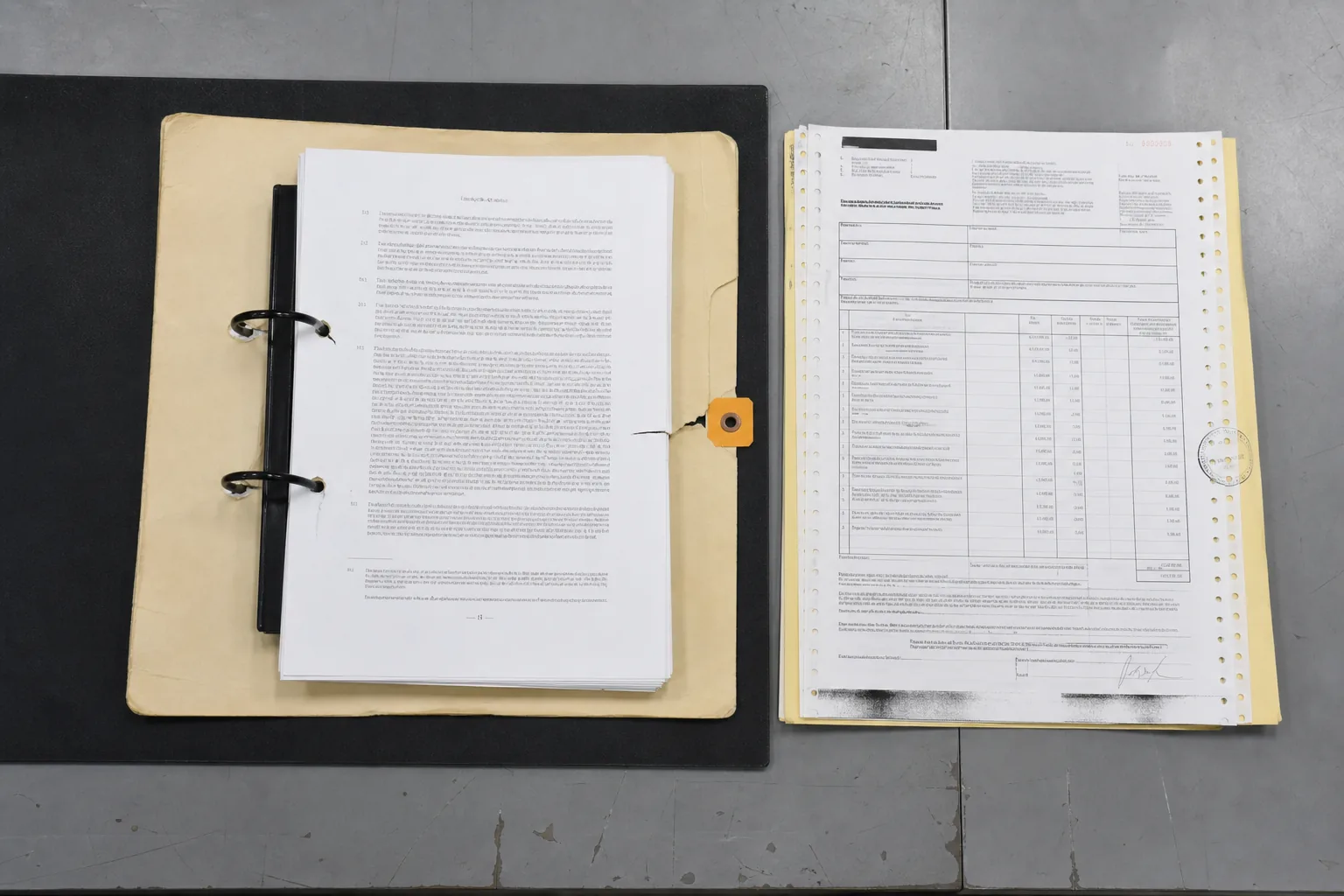
Call it the two-document audit.
It asks your claims who belongs in the inventive entity.
It asks your instruments what they say was transferred or recorded.
It is not a way to determine current ownership, employment, creative merit, or whether an asserted chain is valid.
It shows you a named inventive contribution tied to a pursued claim, beside a documented event tied to the same property, with names and dates still wearing their original labels.
Less magnificent than an ownership graph.
The graph has better lighting.
Neither document is flattered by the question, which is one of the audit’s better qualities.
The procedure
- Inventorship is mapped from claimed conception, one claim at a time, rather than inferred from job title or publication order.
- Natural-person inventor attribution and assignee fields describe different record functions and should remain separate.
- Execution, effective, and recordation dates are distinct labels that should not be collapsed into one transfer date.
- Assignment search results establish recorded-event evidence and do not by themselves decide title or permit an assignee to act in a patent proceeding.
- Identity checks preserve search spellings, database, search date, application-versus-grant scope, and any disambiguated identifier.
- A chain review tests the instrument, property, parties, and later events rather than treating a visible assignee label as present ownership.
Questions
- Does an inventor's name prove that person owns the patent?
- No. An inventor name identifies a natural person in the inventive entity, which is tied to contribution to at least one claim. Ownership can move through a written assignment or another instrument while the inventor field remains unchanged. A patent page can therefore support a statement that a person is named as an inventor, but it does not by itself establish present title, exclusive ownership, or a complete chain of title.
- Can a company be listed as the inventor?
- No. A nonprovisional United States application identifies its inventor or inventors, and an organisation cannot cure an incorrect natural-person inventor list by appearing as applicant or assignee. The inventor field and the assignee field perform different jobs: one attributes claimed inventive contribution to people, while the other can report or record an interest held by an organisation or another recipient.
- How is inventorship checked when the claims change?
- Inventorship is checked against the claims actually pursued. A useful contributor map links one claim to one or more supported contributors and identifies the claimed feature each person conceived. The USPTO recognises that claim changes can require one or more inventors to be added or deleted. A person associated only with a cancelled feature can drop out, while a contribution first claimed in an amendment can require review.
- Does every joint inventor need to contribute to every claim?
- No. A joint inventor need not contribute to every claim, but the contribution must reach claimed conception. The named list can therefore look unlike a product-team roster, author list, reporting line, or seniority chart. Project management, employment position, and publication order are different facts. They do not replace a claim-focused account of a technical contribution.
- What does a recorded patent assignment actually show?
- A recorded patent-assignment result shows a recorded event concerning an identified application, patent, or interest. USPTO assignment search records cover recorded patent-assignment information from 1980 onward and can supply leads about assignments, mergers, name changes, security interests, and corrective filings. The result does not by itself decide validity or title effect, and recordation alone does not permit an assignee to act in a patent proceeding.
- Which dates matter in an assignment history?
- An assignment history keeps the date label supplied by the source, especially execution, effective, and recordation dates. Execution identifies when a party signs an instrument. Recordation identifies when the Office records the submitted document. An effective date can identify a different stated event. Calling all three the transfer date removes the sequence needed to describe what the public record actually shows.
- Is an assignment search enough to prove current ownership?
- No. Assignment search is starting evidence for recorded interests and events, not a warranty that every private title arrangement appears in the result. A chain review asks whether the document is legible, concerns the right property, was executed by the right party, and fits later events. A licence, security interest, corrective filing, or name change can appear in related history without being an outright present assignment.
- What should an assignment timeline include?
- Each assignment event receives at least three fields: assignor, assignee, and the relevant date label. The timeline also retains the application and patent numbers so that an instrument is not silently extended to unrelated filings. Where the record supplies them, execution, effective, and recordation dates remain separate. This establishes a dated sequence of recorded events, not a conclusion that the sequence is a valid complete title chain.
- How can a patent-name search be repeated without mixing up people?
- A repeatable patent-name search records five audit items: database, search date, spellings queried, application-versus-grant scope, and any disambiguated identifier. A raw result can support a statement that a spelling appears on documents. A disambiguated dataset can support a different statement, that its matching system links documents to one entity. The matching rule and extraction date therefore remain part of the result.
- Why can a patent database show several assignees for one invention?
- Several assignees or assignment entries can reflect partial or sequential transfers by co-inventors, as well as licences, security interests, corrections, mergers, or name changes. A recorded assignee measures a reported or recorded relationship to an interest; it does not measure creative contribution. A zero-person company inventor count and a nonzero assignee count are compatible because the records describe different fields.
- Does a wrong inventor name automatically invalidate an issued United States patent?
- No. Under 35 U.S.C. § 256, an error omitting an inventor or naming a noninventor does not invalidate an issued United States patent if it can be corrected under that section. The rule is conditional, not blanket immunity. The implementing rule in 37 CFR § 1.324 provides a correction process involving the required application or court order and specified statements in the stated circumstances.
- What is the smallest useful check of an inventor and assignee record?
- The smallest useful check uses one application or patent number. It maps one claimed feature to the named person's supported contribution, then retrieves the assignment history for that same property. The check records assignor, assignee, and each source-labelled date, plus the database, search date, queried spellings, application-versus-grant scope, and any disambiguated identifier. It establishes a documented distinction, not current ownership.